
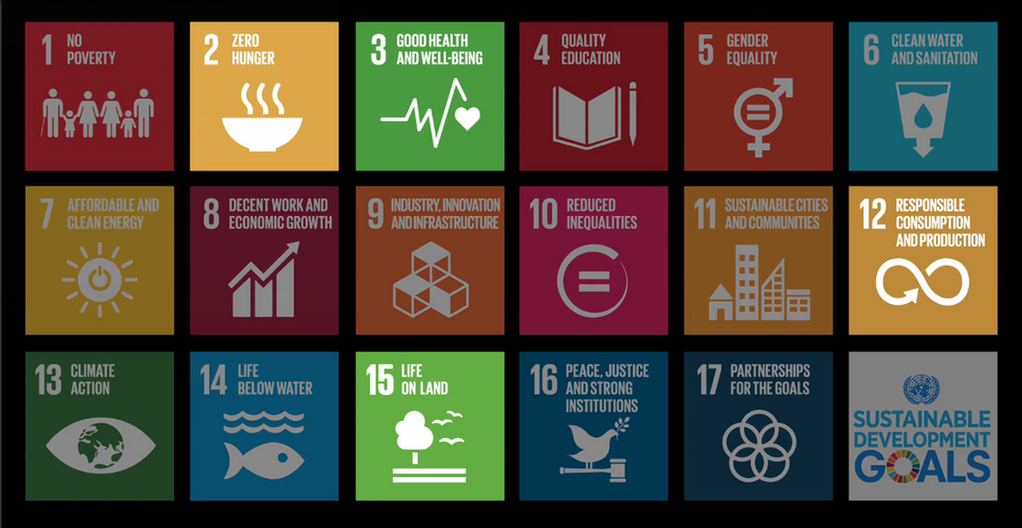
In 2015, countries adopted a new sustainable development agenda and global agreement on climate change.
Soil-health is an important part of at least 4 of these 17 Sustainable Development Goals that the world has set for itself by 2030. Particularly:
- Goal Two: Zero Hunger
- Goal Three: Good Health and Wellbeing
- Goal Twelve: Responsible Consumption and Production
- Goal Fifteen: Life on Land
With individual countries being responsible for the delivery, it is the organisations , both civil and public whom must deliver it. Past experience from the Millennium Development Goals (from 2000-2015) suggest that structural improvements is needed in delivery and finance as the puzzle of a faceted solution to a puzzle of goals lacks any enforcible controls. So it is the word “itself” in referring to the people of Earth that explains the problem.
A tremendous change occurred with the industrial revolution and whereas it had taken almost all of human history, up to the year 1800 for Earths population to reach 1 billion, the second billion was achieved in only 130 years (1930), the third billion in less than 30 years (1959), the fourth billion in 15 years (1974), the fifth billion in 13 years (1987), the sixth billion in 12 years (1999) and then the seventh billion also took 12 years (2011).
At a physical and biological level, our world has many scars of previous development that has already richly delivered such “well-being”, and the word is used advisedly, to many of Earths approximatly 7 500 000 000 people. Clearly we must continue to improve resource usage through change and a deepening understanding of the word sustainable; we must not leave those stunted by low opportunity for happiness behind. Social justice moves further than equality and fairness to resources for opportunity but at the physical and biological level the need is pressing too.
Increasing resource usage and increasing demand in general has transformed the world with agriculture, mining, forestry and giant cities webbed with roads and other hard standings. Trucks delivering food leave pollution in the air but also in the soil. Industrial pollution and chemicals leach into the ground, accumulating in the food we eat and ultimately in our residential homes.
This is not to ignore the problem around of a rising population but ultimately to refine the strategies to support them at the most basic level. The Ground Level!
Click here see the real-time World Population clock.
#DidYouKnow: World Population:
- reached 7 billion on October 31, 2011
- is projected to reach 8 billion by 2024
- has doubled in 40 years from 1959 (3 billion) to 1999 (6 billion)
- is currently growing at a rate of around 1.13 % per year
- growth rate reached its peak in the late 1960s, when it was at 2%
- growth rate is currently declining and is projected to continue to decline in the coming years
- average annual population change is currently estimated at over 80 million
- During the 20th century alone, the population in the world has grew from 1.65 billion to 6 billion.
|Problem Categorisation and Prioritisation
|Solution Options, Ratings and Prioritisation